From Client Onboarding to Payment Tracking: The Complete Guide to Smarter Business Billing
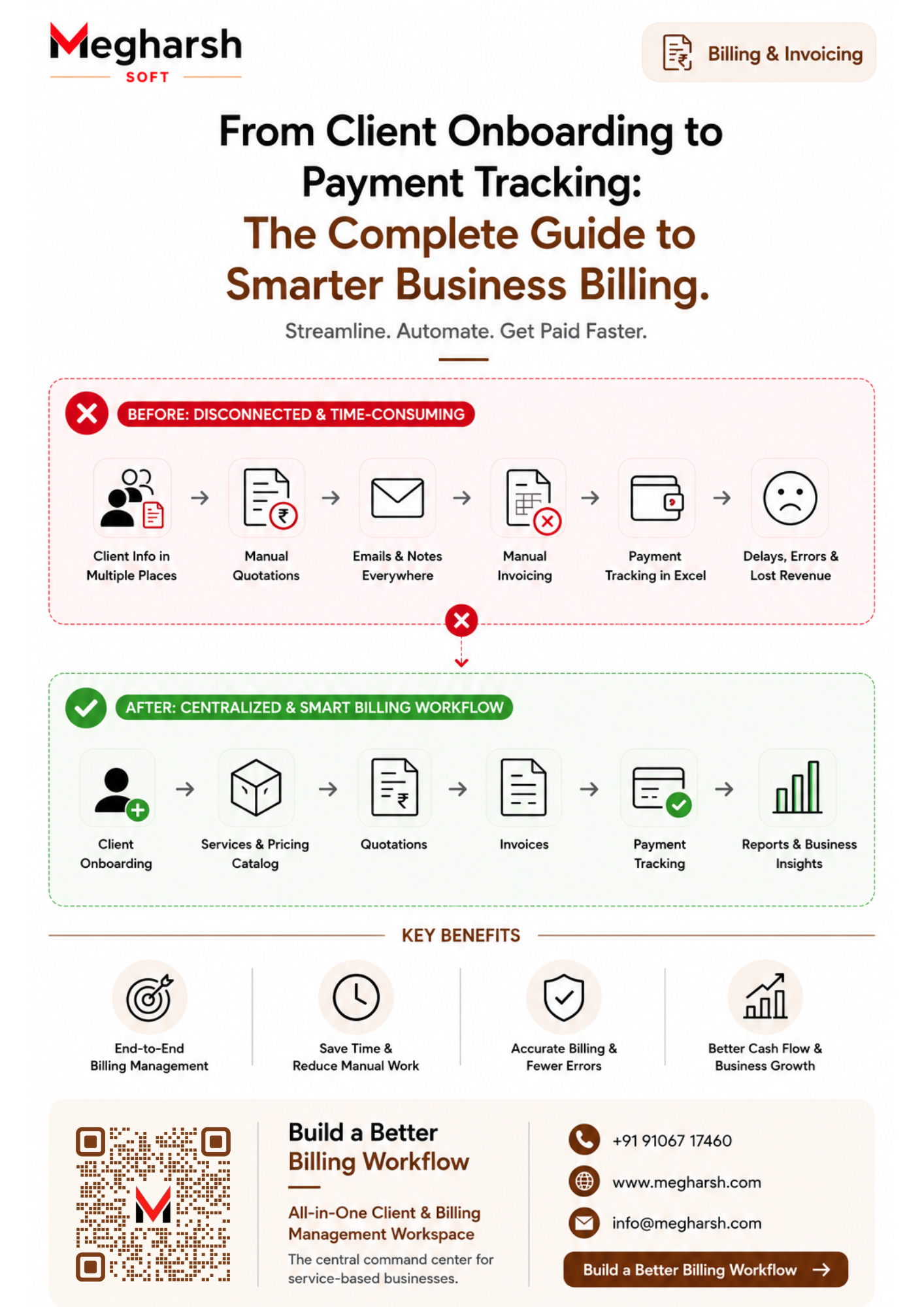
All-in-One Client & Billing Management Workspace: The central command center for service-based businesses.
For many service-based businesses, billing isn't just about creating invoices. It starts much earlier—with managing client information, preparing quotations, tracking services, recording payments, and generating reports.
As your business grows, handling these tasks across multiple spreadsheets, accounting tools, emails, and notes becomes increasingly difficult. Teams spend more time updating records than serving clients, while duplicate entries and disconnected workflows increase the risk of costly mistakes.
A smarter approach is to manage the entire client billing lifecycle from one centralized platform.
Why Traditional Billing Workflows Slow Businesses Down
Many businesses use one tool for client information, another for quotations, separate software for invoicing, and spreadsheets for payment tracking.
While these tools may work individually, they often create challenges such as:
- Re-entering the same client information multiple times
- Inconsistent pricing across quotations and invoices
- Difficulty tracking partial or overdue payments
- Lost client communication and internal notes
- Time-consuming monthly reporting
- Manual follow-ups for recurring invoices
The more clients you manage, the harder these disconnected workflows become.
Start with a Well-Organized Client Database
Every invoice begins with a client.
Keeping all client information in one place makes it easier to manage billing, communication, and project history without searching through emails or spreadsheets.
A centralized client management system allows businesses to:
- Store complete client information
- Update records anytime
- Maintain billing history
- Assign a preferred billing currency for each client
For businesses working with international customers, client-specific currency support helps create invoices in the appropriate currency while keeping records organized.
Standardize Your Services Before Billing
Creating invoices becomes much faster when your services are already defined.
Instead of typing descriptions, pricing, or tax details repeatedly, businesses can create a catalog of products and services that can be reused across quotations and invoices. This helps maintain consistency while reducing manual work.
Whether you're billing for software development, marketing services, consulting, hosting, or domain registrations, predefined services ensure every document follows the same structure.
From Quotation to Invoice—Without Repeating Your Work
Every successful project usually starts with a quotation.
Professional quotations help clients understand the complete scope of work by including service charges, GST, domain costs, hosting fees, and any additional project expenses.
Once the quotation is approved, creating an invoice becomes a seamless process. Simply select the client, choose the required products or services, and generate the invoice.
Businesses can also:
- Save invoices as drafts
- Customize invoice print layouts
- Print professional invoices
- Send invoices directly to clients via email
By connecting quotations, clients, and services within one system, businesses eliminate repetitive data entry and reduce billing errors.
Keep Payments Organized
Sending an invoice is only one part of the billing cycle. Businesses also need to know:
- Which invoices have been paid
- Which payments are partial
- Which clients still have outstanding balances
An integrated payment management system records every payment against its invoice, helping teams maintain accurate financial records without manual reconciliation.
For businesses offering monthly retainers or subscription-based services, recurring billing further reduces administrative effort by automatically managing repeat billing cycles.
Manage More Than Just Invoices
Running a business involves more than billing clients. Internal operations also require:
- Credit notes for billing adjustments
- Task management for teams
- Calendar reminders
- Internal project notes
- Vendor management
- Business documentation
Keeping these activities connected with client records gives teams better visibility into daily operations while reducing the need for multiple disconnected tools.
Turn Business Data into Meaningful Reports
Good decisions require accurate information.
When invoices, quotations, payments, services, vendors, and client records are managed from one platform, reporting becomes simple. Businesses can quickly generate reports for invoices, payments, quotations, services, clients, revenue, and overall business performance.
Instead of spending hours collecting information from different systems, reports are available whenever they're needed.
Ready to Build a Better Billing Workflow?
Managing clients, quotations, invoices, payments, recurring billing, and reports doesn't have to involve multiple applications and manual spreadsheets. A centralized billing platform helps your business stay organized, improve accuracy, and spend less time on administrative work.
Whether you're an IT company, marketing agency, consultancy, freelancer, or any service-based business, your billing process should support your growth—not slow it down.
By connecting every stage of the client journey—from onboarding and quotations to invoicing, payments, and reporting—you create a smoother experience for your team and your clients while gaining complete visibility into your business operations.