
The 100-Day Mortgage Lag: How UK Surveyors Can Future-Proof Their Workflow
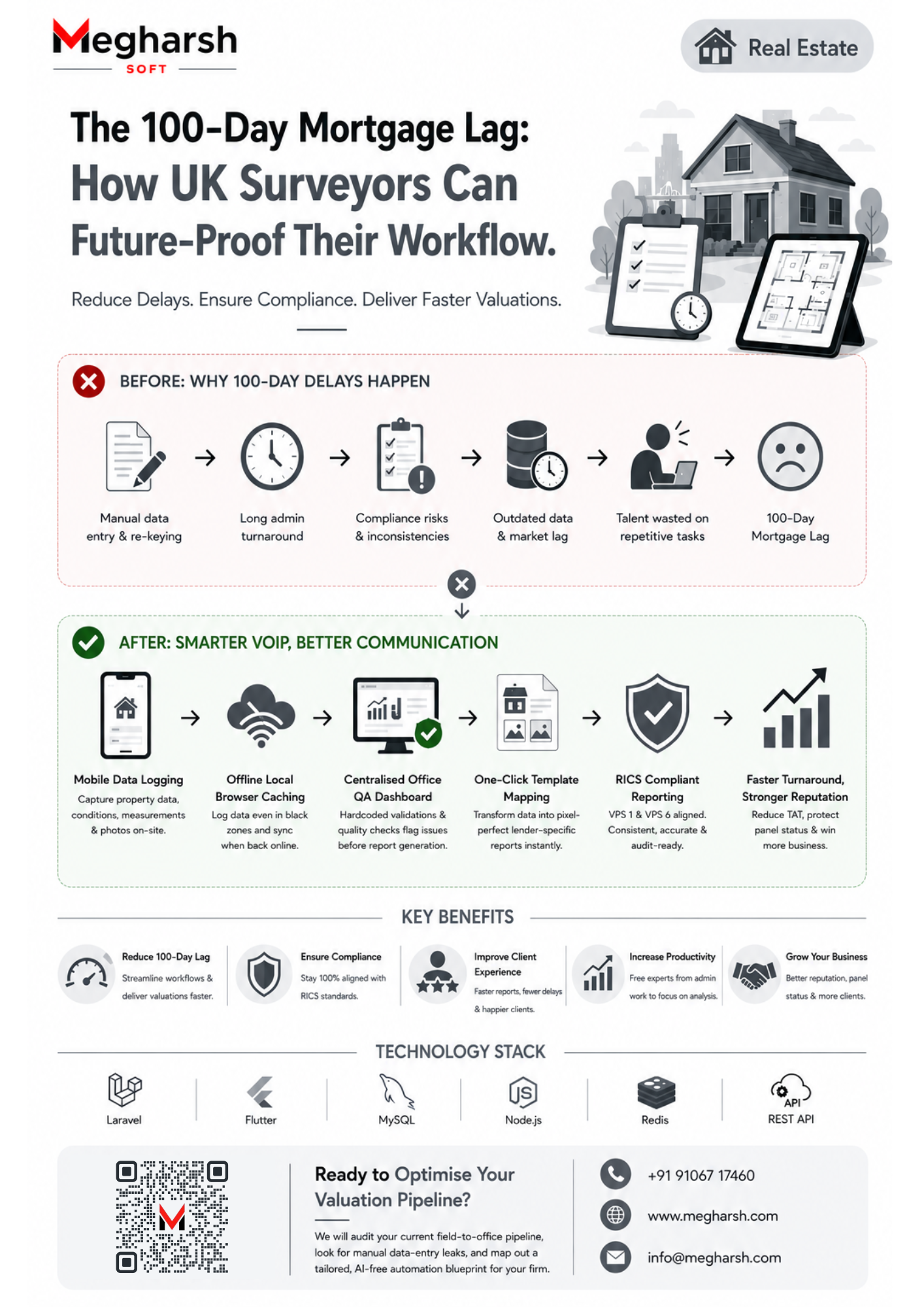
The UK residential property market currently operates under a significant shadow: the 100-day mortgage transaction lag. While market volatility and chain complexities play their part, a large proportion of this delay is driven by the administrative bottleneck inherent in the professional valuation process. From the initial form filling by the buyer to the commission of experts and the eventual report writing, the manual reporting pipeline is a primary source of friction that modern firms must address.
Currently, 1,415 registered UK residential surveying firms are tasked with managing a 10-year average of over 61,000 transactions per month. This places a staggering workload on the profession, requiring each firm to handle an average of 43.62 valuations for residential mortgages every single month. For many firms, this volume is managed through "mundane and repetitive" administrative steps that detract from high-value expert analysis.
To remain competitive and protect panel status, firms must move beyond manual re-keying and adopt deterministic, predictable workflow engines that modernise the field-to-office pipeline.
The Compliance Axis: Data Integrity & RICS Standards
In the rigorous world of UK property valuation, compliance with the RICS Valuation – Global Standards (the ‘Red Book’) is non-negotiable. Specifically, mandatory requirements such as VPS 1 (Terms of Engagement) and VPS 6 (Report Content) demand absolute consistency. Traditionally, the transition from agreed terms to the final valuation report is a manual "copy and paste" exercise, which introduces an unacceptable risk of "repetition, ambiguity, contradiction and omission".
Manual reporting also exposes firms to psychological and data-driven distortions. Valuation professionals are often susceptible to "anchoring bias," where a previous estimate or a pending sale price subconsciously influences the appraisal. Furthermore, reliance on manual data entry from historical land registry records can result in a 3-to-6-month lag, meaning valuations may not reflect current market shifts during periods of rapid movement. Standardised digital frameworks protect data integrity by ensuring that the statement of the scope of inspection is perfectly aligned between the engagement terms and the final report, effectively eliminating human anchoring and manual entry errors.
The Solution: A Deterministic Workflow Engine
The future of efficient reporting lies in a cloud-native database platform—built on robust Laravel and MySQL architecture—that provides 100% data predictability without the unpredictability of automated models. This software-driven approach focuses on a seamless field-to-office pipeline through several key technical layers:
- Mobile Data Logging: Surveyors can use mobile-web input fields on-site to capture condition details, measurements, and photos directly into the database.
- Offline Local Browser Caching: To account for "black zones" in rural UK locations, the platform utilises offline synchronisation, allowing data to be logged without an internet connection and synced once back in range.
- Centralised Office QA Dashboard: Raw data is fed into a centralized dashboard where hardcoded validation rules and quality control protocols flag anomalies before they reach the client.
- One-Click Template Mapping: Raw property data is transformed instantly into pixel-perfect, customisable templates that fit the specific requirements of major UK lenders and building societies, such as Nationwide, Halifax, Barclays, and HSBC.
By using a 100% deterministic engine, firms can ensure that every report is formatted perfectly for client-specific templates every time, eliminating the time-intensive "preparing, writing and returning" phase that currently eats into the 100-day transaction window.
Talent & Reputation: Moving Beyond Administrative Drudgery
The administrative bottleneck is not just a process problem; it is a talent problem. The pool of qualified UK appraisers is dwindling due to age distributions and a historic inability to attract new talent to handle standard, repetitive residential work. When highly paid, expert Chartered Surveyors are forced to spend hours on manual formatting and data re-keying, their professional value is eroded.
By automating the mundane reporting pipeline, firms can free their experts to focus on strategic client advice and the analysis of unorthodox dwellings that require genuine human judgment. This modernisation protects a firm's reputation by drastically reducing Turnaround Times (TAT), thereby shielding clients from "gazumping" and ensuring the firm maintains its preferred status on lender panels.
Ready to Optimise Your Valuation Pipeline?
In an era where liquidity and speed define market success, your firm cannot afford to be held back by analogue reporting processes.
Is your field-to-office pipeline leaking time? Are manual formatting errors putting your RICS compliance at risk?
We will audit your current field-to-office pipeline, look for manual data-entry leaks, and map out a tailored, AI-free automation blueprint for your firm.